Innovating
Smart Neurotech

For balanced pressure and flow

Innovating
Smart Neurotech

For balanced pressure and flow

SmartShuntTM

Hydrocephalus Management System

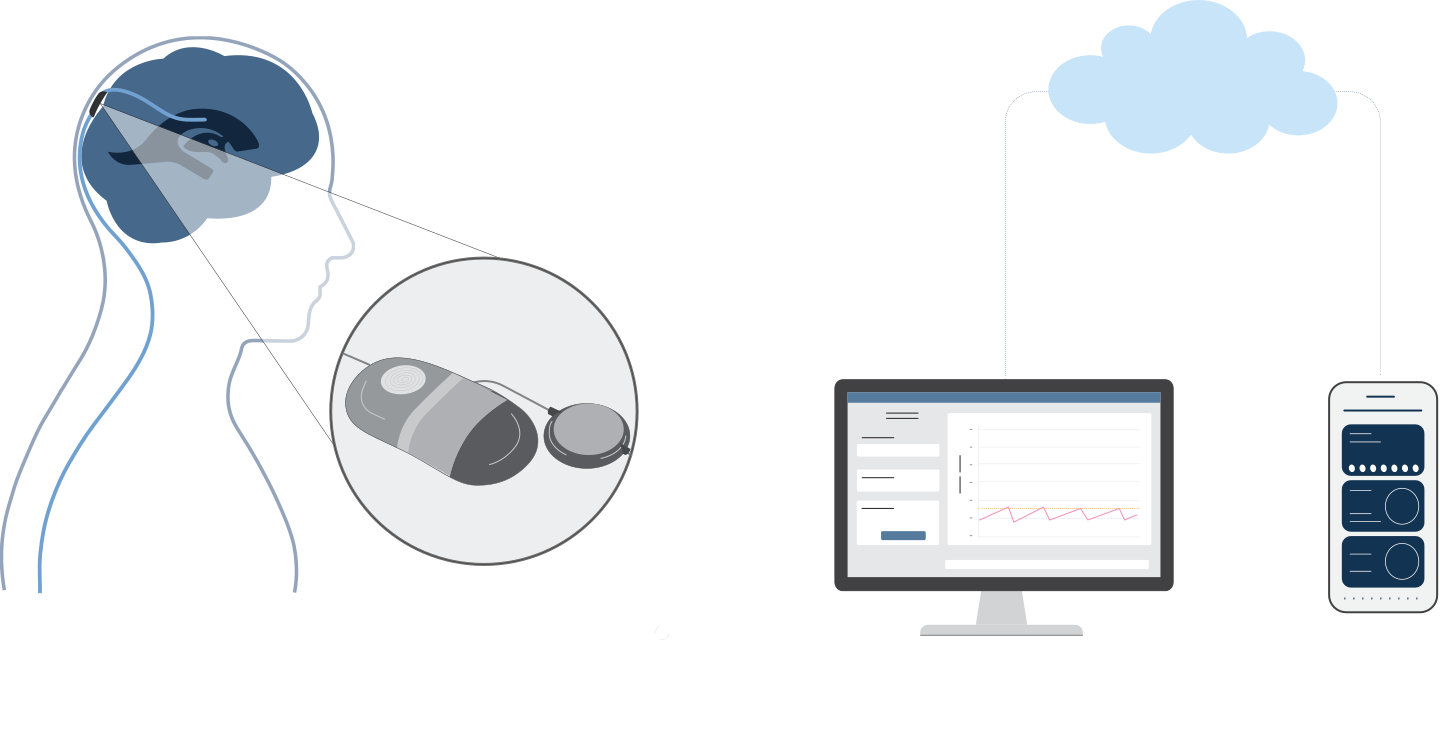
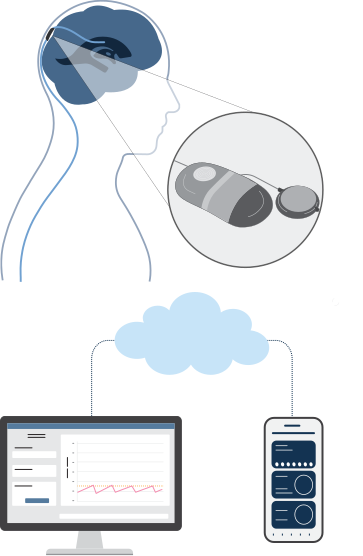
MadSci’s platform technology pairs state-of-the-art electromechanical valve technology with intelligent sensing and algorithms to enable personalized and informed management of neurologic conditions. This first application of our advanced technology is the SmartShuntTM System designed to optimize management of patients with hydrocephalus.

Intelligent
Valve Activation

Informed
Patient Management

Intelligent
Valve Activation

Informed
Patient Management

Hydrocephalus

Hydrocephalus is caused by a buildup of cerebrospinal fluid (CSF) in the brain’s ventricles, which can increase intracranial pressure and lead to neurological problems or even death if untreated.

Over 1 million children and adults impacted in the U.S.1

Hydrocephalus symptoms present differently between children and adults.
Pediatric hydrocephalus‭ ‬can be diagnosed in‮ ‬utero‭ ‬through adolescence‭.‬ Hydrocephalus is as common as Down syndrome and more common than spina bifida or brain tumors.1

Symptoms include2:

  • Macrocephaly (or abnormal growth of head circumference)
  • Vomiting
  • Behavior change (including irritability)
  • Drowsiness or lethargy
  • Headache
  • Stiff neck or backache

Adult patients are most commonly diagnosed with normal pressure hydrocephalus (NPH).
NPH may impact 6.8‭ ‬million adults‭ ‬worldwide3‭ ‬but may be misdiagnosed as Alzheimer’s or Parkinson’s‭.‬ 80% of cases remain unrecognized or untreated.4

Symptoms include:
  • Dementia
  • Gait instability
  • Urinary incontinence

When correctly diagnosed and treated, patients can return to a fully functioning lifestyle.
The current standard of care is the surgical placement of a permanent shunt to drain excess CSF from the brain to alleviate pressure and prevent brain damage.5 For pediatric patients, shunts have greatly improved survival rates and allowed for daily activity. For adults with NPH, shunting has been demonstrated to deliver significant improvements in gait velocity and balance.6
Shunts have one of the highest medical device failure rates yet the technology has remained the same since the 1950s.1 A failed shunt can require multiple repeat procedures or shunt replacements, placing an emotional and financial burden on patients and families.2 Subdural hematomas are a common side‭ ‬effect for adults‭.‬

High shunt failure rates

For children, shunts fail nearly 40% within 1 year, 80% within 3 years7

In adults, shunts are prone to fail as often as 15% of the time8

0 %+

Of shunt surgeries represent emergencies1

0 %

Patients have‭ ≥10‭ ‬life-time revisions9

$ 0 B+

In hospital costs‭ / ‬year

Company

At Madison Scientific (MadSci), we are innovating smart electromechanical devices to improve the treatment and long-term care of patients suffering from neurologic conditions.

Tyler Wanke MD, MBA, MEM
President & CEO, Co-Founder
Michael Nagy
Chief Technology Officer
Bermans Iskandar MD
Chief Medical Officer
David Wesner
Chief People Officer & VP, Operations
Joshua Carson PhD
Board Member
John Slump
Board Member
Tyler Wanke MD, MBA, MEM
Board Member
Bermans Iskandar MD
Board Member
Josh Medow MD, PhD
Co-Founder, Board Member
Elizabeth Hagerman PhD
Board Member
Haven Allen MPP
Board Member
Sandi Lam MD, MBA
Division Head, Neurosurgery; Yeager Professorship in Pediatric Neurosurgery, Northwestern University Feinberg School of Medicine
David Hsu MD, PhD
Co-Founder, Madison Scientific Professor of Neurology, University of Wisconsin, Madison
Christopher Luzzio MD
Co-Founder, Madison Scientific Neurologist, University of Wisconsin School of Medicine and Public Health
The Batterman Family
Christopher, Angela, and Joseph Hydrocephalus advocates
Alexei Mlodinow MD, MBA
Serial Entrepreneur and Surgeon
Eric Heinz
Founder and Managing Partner, Heinz Ventures

News

MadSci Announces $10 Million Oversubscribed Seed Financing to Advance Smart Technology for Neurologic Conditions

Madison Scientific Closes $7M in Seed Financing.

What is normal pressure‭ ‬hydrocephalus‭? ‬Billy Joel’s condition is often treatable

Partners & Collaborators

Contact

Interested in following news from MadSci?

Complete the form to receive regular updates from MadSci.

  1. Hydrocephalus Association Fact Sheet.
  2. Kahle, K., et al. “Hydrocephalus in children”. The Lancet. Volume 387, Issue 10020. p788-799. February 20, 2016. doi: 10.1016/S0140-6736(15)60694-8.
  3. Isaacs AM, et al. “Age-specific global epidemiology of hydrocephalus: Systematic review, metanalysis and global birth surveillance.” PLoS One. 2018 Oct 1;13(10):e0204926. https://doi.org/10.1371/journal.pone.0210851.
  4. Hydrocephalus Association NPH Fact Sheet.
  5. Allied Market Research, Hydrocephalus Shunt Market, Global Opportunity Analysis and Industry Forecast, 2020-2027.
  6. Luciano et al. “A Randomized Trial of Shunting for Idiopathic Normal-Pressure Hydrocephalus.” N Engl J Med. 2025 Sep 16. doi: 10.1056/NEJMoa2503109.
  7. Drake et al. “Randomized Trial of Cerebrospinal Fluid Shunt Valve Design in Pediatric Hydrocephalus”. Neurosurgery 43(2):p 294-303, August 1998.
  8. Nigim, F., et al. “Shunting for hydrocephalus: analysis of techniques and failure patterns”. Journal of Surgical Research. 2014. Vol 191, pg140-147. http://dx.doi.org/10.1016/j.jss.2014.03.075.
  9. Mitchell‭ ‬KA‭, ‬et al‭. ‬J Craniofac Surg 2021‭. ‬Jul-Aug:32‭(‬5‭): ‬1746-1750